Categories
How the Lean Startup Can Help You Reduce the Risk in Innovation (Part Two)
Lean Startup what is it, why it’s relevant to you, and its advantages.
This article is part two of Monthly Dose of Design’s seven-part series New Ways of Working for Market Researchers. Part one, New Ways of Working to Help Researchers Solve Problems, Test and Build Solutions, can be found here.
What is the Lean Startup?
The Lean Startup is an iterative process used for developing products or services based on what people want. The Lean Startup values experimentation, consumer feedback, and iterative design. It prioritizes speed, aims to eliminate any unknown factors in product or service development, test assumptions, and shorten development cycles. This is done by rapidly testing solutions, getting feedback on them by measuring their performance, and improving them based upon the feedback received.
Why is the Lean Startup relevant to you?
It plays to market researchers’ strengths
Market research explores, tests, and identifies consumers’ needs and pain points. The Lean Startup works like this too, by continuously testing solutions and applying learnings to better them. Customer interaction and feedback are crucial, as this provides insights into what improvements must be made.
It helps market researchers play a part in innovation for businesses
The Lean Startup is geared towards NPD (new product development). This means it can help you by testing prototypes and using consumer feedback to optimise them. In doing so, this reduces the chance of a new product failing when it’s launched.
The key values to the Lean startup are:
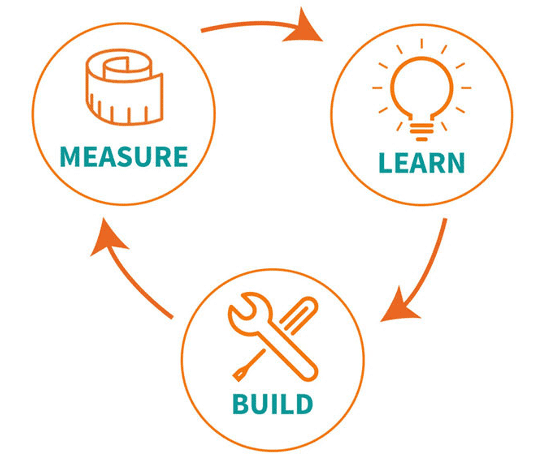
Image: JTR Solutions
The Lean Startup framework works on the Build–Measure–Learn loop. This loop is a learning cycle that involves building ideas quickly into rudimentary products, measuring customers’ reactions, and improving the production in three key stages:
- Build: Start by creating a Minimum Viable Product (MVP) – a cheap and rudimentary version of the actual product or a prototype, which will be used in market testing. Why? By building a minimum viable product, you can quickly test your product and fail fast early on. Failing with an MVP is significantly cheaper than a real product failing.
- Measure: Once you have an MVP or prototype, the next step is to test with consumers. This is where market researchers thrive, by using methods such as surveys, data analytics, interviews, and focus groups to gain consumer feedback and insight. Why? This feedback and insights are needed to improve the next iteration of your product.
- Learn: Once you’ve identified what works and what fails in the market you need to improve the product by eliminating pitfalls and leveraging areas of success. Why? This ensures that your new product meets the market’s expectations.
The Lean Startup has three main advantages:
- Eliminating uncertainty: The Lean Startup is more than learning fast and failing cheap. It allows you to de-risk your product quickly and reduce financial loss. This allows market researchers to help companies to develop confidence in their business ideas before turning them into products or services.
- Validated learnings: This feedback-focused development process enables you to focus your resources in the right places. This increases productivity and allows you to see if the product is viable before investing more time and money into it.
- Systematic approach for innovation: This systematic approach requires fast thinking and action to make for a simple yet efficient model of working.
Next month…
We’ll discuss how combining Lean Startup and Design Thinking can benefit market researchers.
Header Image: Brands&People, Unsplash
Comments
Comments are moderated to ensure respect towards the author and to prevent spam or self-promotion. Your comment may be edited, rejected, or approved based on these criteria. By commenting, you accept these terms and take responsibility for your contributions.
Disclaimer
The views, opinions, data, and methodologies expressed above are those of the contributor(s) and do not necessarily reflect or represent the official policies, positions, or beliefs of Greenbook.
More from Emma Galvin
The Fundamentals of Layout Design for Insights
5 min read
Data visualization is easy with basic design layout design principles.
Innovation Management: Barriers to Innovation (Part Five)
3 min read
The five main barriers to innovation.
Innovation Management: Disruptive Innovation (Part Four)
3 min read
Disruptive innovation: What it is and why it’s important to MR.
Innovation Management: Breakthrough/Radical Innovation (Part Three)
3 min read
Diving into breakthrough/radical innovation and how it applies to MR.
ARTICLES
Top in Research Methodologies
How to Write a Great Case Study in the Insights and Analytics Industry
3 min read
Discover how impactful case studies connect data to decisions. Learn to craft compelling narratives that showcase research's vital role in driving bus...
Karen Lynch
Editor-in-Chief at Greenbook
Partner Content
The Lines around User and Market Research Are Blurring, so What Happens Next?
How are research roles changing? Explore how AI, rising demand, and earlier involvement are reshaping market and user research.
Louise Jones
Senior Brand Manager at Maze
When Bad Online Sample Looks Good Enough
How can survey fraud survive quality checks? Learn what research buyers should ask to evaluate respondent quality and data integrity.
Chandra Limiarja
Data Analyst at Independent
Are We Cleaning Too Much? The Missing Signals in Post-Survey Review
How can AI improve survey data cleaning? Learn how richer fieldwork signals can reduce false positives and increase confidence.
Karine Pepin
Co-Founder at The Research Heads

Sign Up for
Updates
Get content that matters, written by top insights industry experts, delivered right to your inbox.


