Categories
Using Design as a Process (Part 2)
How you can use a design process to improve your services, products, or brand and provide more value to clients.
Editor’s Note: This article is part two in the three-part series The Design Ladder.
Last month we introduced the Design Ladder by the Danish Design Centre. We discussed the ladder’s different design levels, how it can be used to identify where your company currently sits, how further design implementation can be used to improve your client’s product and their business and how to use design as an aesthetic.
Moving up the ladder, we go from design’s execution to design thinking. This month we’re at level three; design as a process which is part of Design Thinking.
What is design as a process?
A process is defined as ‘a series of actions taken to reach an end goal’. The end goal can be creating or improving a service, product or brand. Design as a process involves incorporating design into a process’s early stages, or using a design process, (like Design Thinking), to help create better products, services, or brands.
How can you use design as a process?
Market researchers can use design as a process both:
- Internally to improve their service, products or their brand within the industry, or
- Externally to provide more value to clients
What type of design process can you use?
Many different design processes exist. And no single design process fits all industries or companies. There are some design processes that can be modified to fit different purposes or company cultures. The design processes shown below are used in different industries from engineering to market research.

The source of this material is the Design Council at www.designcouncil.org.uk. All rights reserved.
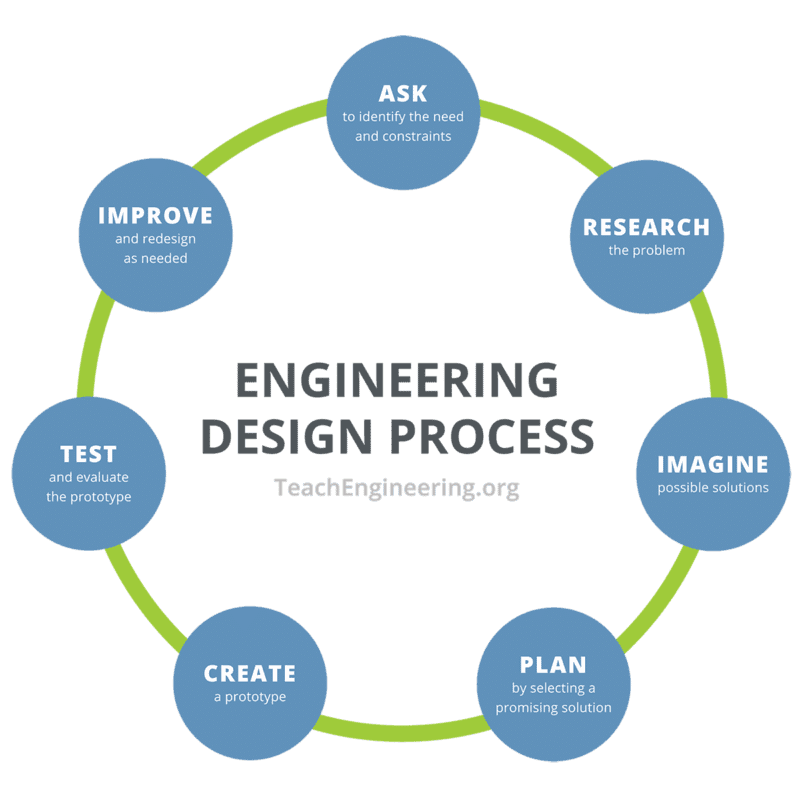
The source of this material is the TeachEngineering digital library collection at www.TeachEngineering.org. All rights reserved.
Stage 1: Research, understanding, empathy
This stage always occurs at the process’ beginning and requires:
- Market research
- User research
- Design research
The aim here is to gather lots of information on the target audience’s behaviours, problems, and perceptions. These insights will then be used as the foundation for the products, brands or services which are being designed. This will ensure that you are designing with the user in mind.
Stage 2: Design, prototyping, developing
Using the insights uncovered in stage 1, you can now start designing the right solutions and requires:
- Brand design
- Business design
- UX/UI design
- Graphic design
- Project development
Great insights aren’t enough and they need to be brought to life. The aim of stage 2 is to develop insights into solutions for the problems uncovered in stage 1. These are then developed into high or low-fidelity prototypes. A prototype’s fidelity level refers to how much it will match the final solution. For example, a low-fidelity prototype could be a paper interface, whereas a high-fidelity prototype could be a video walkthrough of an app. From here you can test your prototype.
Stage 3: Test, learn, reiterate
Compared to traditional processes, stage 3 is what makes the design process effective. This stage requires:
- Market research
- User testing
- Feedback groups
Stage 3 tests your prototypes, learns from their successes and failures, re-designs them, then re-tests them based on user feedback. Here, you measure the results that you obtained in Stage 2.
- How did the prototype fair compared to the hypothesis?
- How do your customers or stakeholders feel about your idea?
- Do the insights and data show that this will lead to a successful product, service, or brand?
- Should you continue developing it?
Why should you implement design as a process?
By using a design process, you can ensure that design is well implemented. This results in good design that’s based on understanding people and validated by testing. Good design leads to improved products, services, and brands.
How can you implement a design process into your organisation?
- Develop your own design process and techniques
There are many different design processes and there’s no one size fits all. However, by incorporating the three key stages into your organisation’s process, you can design a process that is well suited to your organisation’s needs. - Promote formal but flexible control of the design process
A design process is never ridged. Most frameworks shown serve as guidelines and must adapt to the users’ and stakeholders’ needs. - Foster a corporate culture that values design
A design process is a process that must be considered from start to finish across an organisation. It can’t work within silos and requires participation from everyone from clients to stakeholders. Therefore, a corporate culture that values design needs to foster an environment where design processes can be integrated into the business.
Next month…
In next month’s Monthly Dose of Design, we’ll discuss level four, using design as a strategy.
Header Image: Kaboompics .com, Pexels
Comments
Comments are moderated to ensure respect towards the author and to prevent spam or self-promotion. Your comment may be edited, rejected, or approved based on these criteria. By commenting, you accept these terms and take responsibility for your contributions.
Disclaimer
The views, opinions, data, and methodologies expressed above are those of the contributor(s) and do not necessarily reflect or represent the official policies, positions, or beliefs of Greenbook.
More from Emma Galvin
The Fundamentals of Layout Design for Insights
5 min read
Data visualization is easy with basic design layout design principles.
Innovation Management: Barriers to Innovation (Part Five)
3 min read
The five main barriers to innovation.
Innovation Management: Disruptive Innovation (Part Four)
3 min read
Disruptive innovation: What it is and why it’s important to MR.
Innovation Management: Breakthrough/Radical Innovation (Part Three)
3 min read
Diving into breakthrough/radical innovation and how it applies to MR.
ARTICLES
Top in Research Methodologies
Partner Content
The Lines around User and Market Research Are Blurring, so What Happens Next?
How are research roles changing? Explore how AI, rising demand, and earlier involvement are reshaping market and user research.
Louise Jones
Senior Brand Manager at Maze
When Bad Online Sample Looks Good Enough
How can survey fraud survive quality checks? Learn what research buyers should ask to evaluate respondent quality and data integrity.
Chandra Limiarja
Data Analyst at Independent
Are We Cleaning Too Much? The Missing Signals in Post-Survey Review
How can AI improve survey data cleaning? Learn how richer fieldwork signals can reduce false positives and increase confidence.
Karine Pepin
Co-Founder at The Research Heads
The Career Case for Pro Bono Research
Discover how to choose, scope, and pitch pro bono research projects that build skills, strengthen your resume, and advance your career.
Shawn Keys
Coordinator at KNow Research

Sign Up for
Updates
Get content that matters, written by top insights industry experts, delivered right to your inbox.


